Is PUF Panel Fire Resistant? Fire Safety Explained
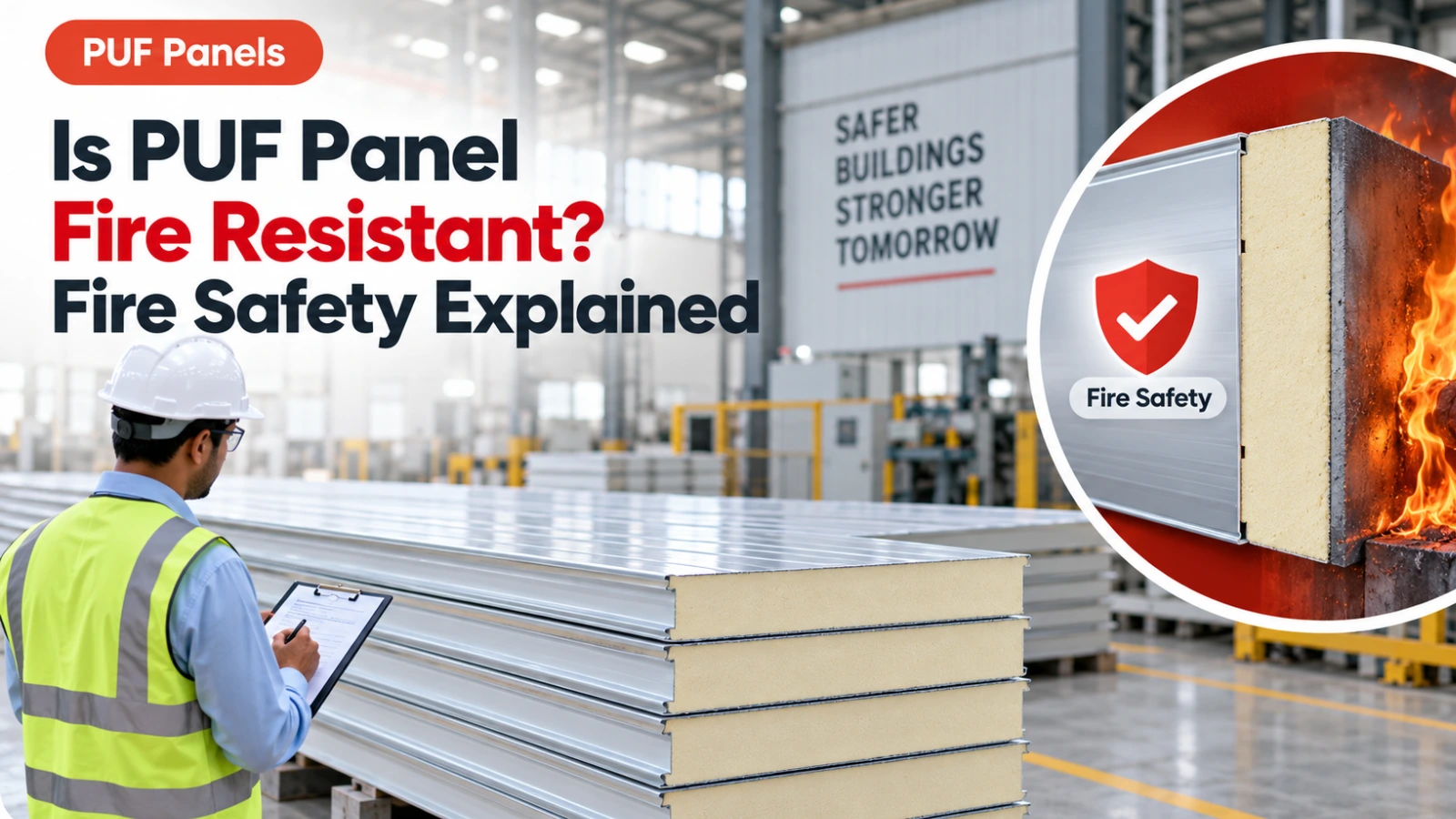
PUF panels are widely used in cold rooms, warehouses, industrial buildings, clean rooms and insulated roofing systems. They are popular because they are lightweight, provide good thermal insulation and can be installed quickly.
But when fire safety is a priority, one important question comes up: Is PUF panel fire-resistant?
The answer is not simply yes or no. Standard polyurethane foam is a combustible material. However, PUF panels can be manufactured with fire-retardant properties that help reduce flame spread and improve their performance during a fire.
The actual fire performance depends on the foam formulation, panel construction, steel facings, joints, thickness and the fire test or classification used.
In India, prefabricated polyurethane sandwich panels are covered by IS 16203:2016, while other Indian Standards cover related polyurethane insulation materials and fire testing methods.
BIS also provides a central platform for checking current standards and related documents.
Let us understand what this means in practical terms.
What Is a PUF Panel?
A PUF panel is a sandwich panel made with a rigid polyurethane foam core placed between two protective metal sheets, usually coated or galvanised steel.
The foam core provides the insulation. The outer sheets provide strength, protection and a finished surface.
PUF panels are commonly used for:
- Cold storage and refrigerated rooms
- Food processing facilities
- Warehouses
- Clean rooms
- Industrial buildings
- Insulated roofs and walls
- Air-conditioned spaces
- Prefabricated structures
Is PUF Panel Fire Resistant?
A standard PUF panel should not be described as completely fireproof. Polyurethane foam is an organic polymer and can burn when exposed to sufficient heat and an ignition source.
That said, specially formulated fire-retardant PUF panels can offer improved behaviour when exposed to fire.
These panels are designed to:
- Reduce the speed at which flames spread.
- Delay ignition and burning
- Reduce the contribution of the foam to fire growth.
- Self-extinguish under suitable conditions after the flame source is removed
- Provide more time for occupants to respond to a fire.
How Do Fire-Retardant PUF Panels Work?
Fire-retardant PUF panels are produced by modifying the foam formulation and, depending on the product, using additives that improve its reaction to fire.
Here is how the process generally works:
- Flame-Retardant Additives: Special chemicals can be incorporated into the polyurethane foam during manufacturing. These additives are selected to slow down combustion and reduce flame propagation. The formulation needs to be carefully controlled because the final fire performance depends on more than simply adding a flame-retardant chemical.
- Char Formation: When exposed to high heat, certain fire-retardant polyurethane formulations can form a protective char layer. This layer can act as a barrier between the heat source and the material underneath. It may slow further decomposition and reduce the availability of combustible gases.
- Self-Extinguishing Behaviour: Some fire-retardant grades are designed to stop burning once the direct ignition source is removed. This is known as self-extinguishing behaviour. However, self-extinguishing should not be confused with fireproofing. If a panel is exposed to a severe or continuous fire, the foam can still deteriorate.
Fire Rating vs Fire Resistance: What Is the Difference?
This is one of the most important points to understand.
Fire rating describes how a material or building element performs when tested against a defined fire-related criterion.
Fire resistance usually refers to the ability of a building element or assembly to maintain specified performance for a particular period under standard fire exposure.
For example, a wall assembly may be tested for its ability to maintain integrity or insulation for a stated period.
Therefore, saying that a PUF panel is "fire resistant" without mentioning the relevant test result can be misleading.
A product specification should ideally state:
- The test standard used
- The classification achieved
- Test conditions
- Panel thickness
- Core density and formulation
- Facing material
- Joint and installation details
What Do Indian Standards Say About PUF Panels?
Indian Standards provide important guidance for polyurethane insulation and prefabricated sandwich panels.
IS 16203:2016 – Prefabricated Polyurethane Sandwich Panels — Specification sets requirements for PUF sandwich panels. The standard includes a requirement related to surface spread of flame and refers to IS 13286 for the relevant test method.
Other standards cover the properties and testing of rigid polyurethane and related insulation materials. For example, BIS lists IS 12436:1988 for preformed rigid polyurethane (PUR) and polyisocyanurate (PIR) foams used for thermal insulation. BIS also lists testing standards covering properties such as flammability and flame-related behaviour.
This highlights an important point: there is no single number or label that tells you everything about the fire safety of a PUF panel.
The product needs to be evaluated against the appropriate requirement for its intended application.
Standard PUF vs Fire-Retardant PUF vs PIR
- Standard PUF: Standard PUF is primarily selected for its insulation properties. Since polyurethane foam is combustible, it should not be treated as a non-combustible construction material.
- Fire-Retardant PUF: Fire-retardant PUF is specially formulated to reduce flame spread and improve behaviour during fire exposure. It can be a practical option when both thermal insulation and improved fire performance are required.
- PIR Panels: PIR, or polyisocyanurate, is chemically related to polyurethane but has a different structure. It generally offers better resistance to higher temperatures and fire than conventional PUF.
- Rockwool Panels: Rockwool panels use mineral wool rather than a polymer foam core. Mineral wool is non-combustible and is therefore often preferred for applications where fire safety is a major design requirement. The right choice depends on the building, fire strategy, regulations and required performance.
What Factors Affect PUF Panel Fire Performance?
Simply choosing a panel labelled "fire retardant" is not enough. Several factors influence how the complete system behaves during a fire.
- Core Density and Formulation: The density and chemical formulation of the foam affect its combustion characteristics and thermal behaviour.
- Panel Thickness: A thicker panel does not automatically mean a better fire rating. Fire performance must be established through the relevant test or classification.
- Metal Facings: Steel facings can protect the foam core and influence how the panel behaves when exposed to heat.
- Panel Joints: Joints are often overlooked. Poorly designed or incorrectly installed joints can create gaps through which heat, smoke or flames may travel.
- Installation Quality: Even a tested panel can perform poorly if it is incorrectly installed. Fasteners, seals, flashings, openings and penetrations all need attention.
- Building Design: Fire safety is not determined by the wall or roof panel alone. The complete building system, escape routes, fire detection, compartmentation and firefighting arrangements also matter.
How to Choose a Fire-Safe PUF Panel?
If you are evaluating a PUF panel for an industrial, commercial or specialised facility, look beyond the basic product brochure.
Ask the manufacturer or supplier for:
- Fire test reports relevant to the intended application.
- Applicable BIS or other recognised standards followed by the product.
- Details of the foam core formulation and density.
- Fire classification or flame-spread results, where applicable.
- Details of the complete panel assembly, including facings and joints.
- Installation instructions and approved jointing details.
- Test certificates from recognised laboratories, where required.
PUF Panels Can Be Safe When the Right Specification Is Used
So, is the PUF panel fire resistant? The most accurate answer is that standard PUF is combustible, while specially formulated fire-retardant PUF panels can provide improved resistance to flame spread and better fire behaviour.
For projects where fire safety is a key concern, the decision should be based on tested performance rather than a simple product label. Consider the panel's core, facing, thickness, joints, installation method and the applicable fire requirements together.
Where a project requires a higher level of fire performance, PIR or non-combustible mineral wool panels may be more suitable alternatives.
Ultimately, the safest approach is to choose a panel based on verified test results, applicable Indian Standards and the actual requirements of the building. This ensures that thermal insulation does not come at the cost of fire safety.