PUF Panel Standards and Certifications in India (BIS, ISO, Fire Rating)
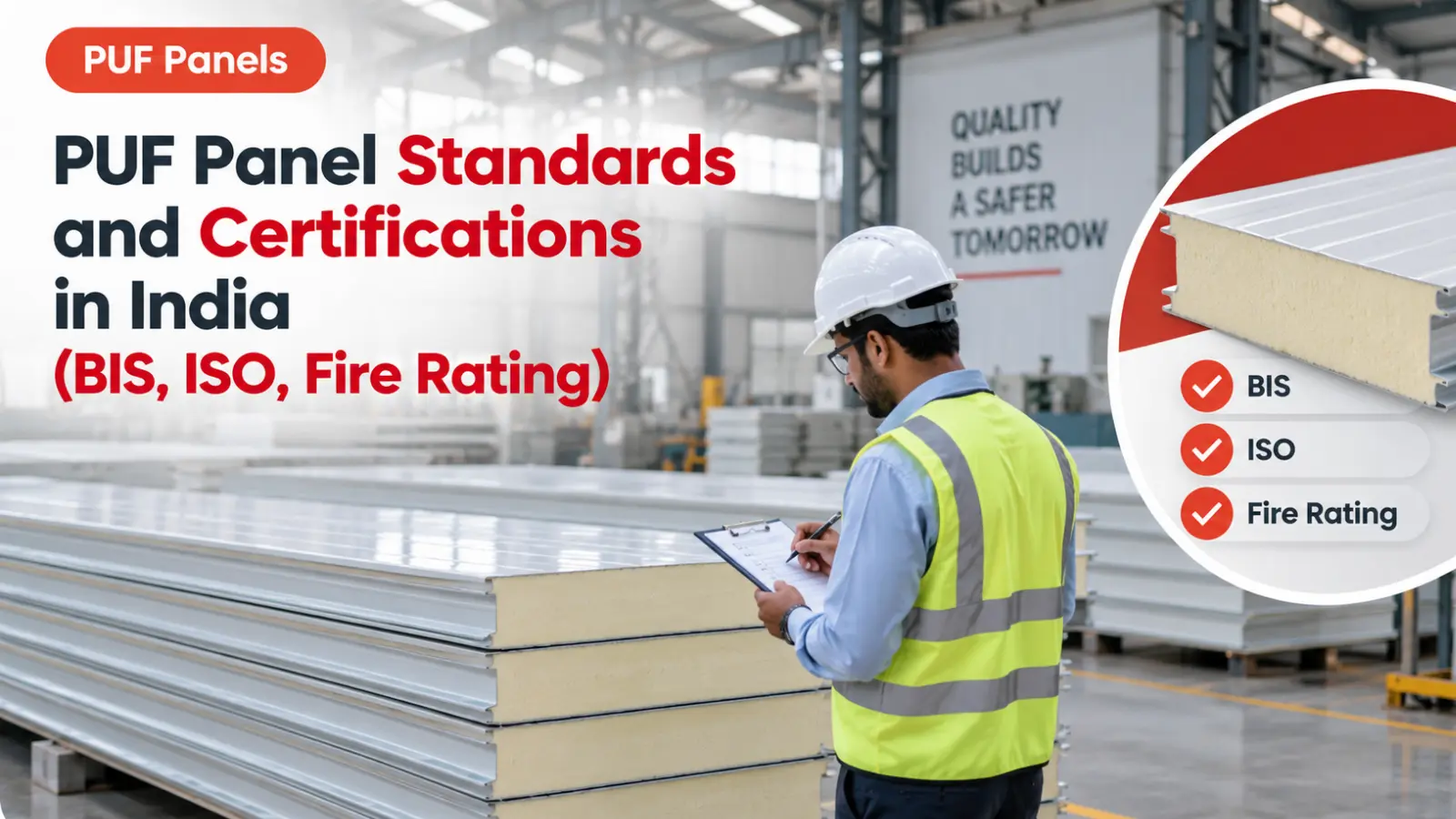
PUF panels are widely used in cold storage facilities, warehouses, cleanrooms, food processing units, pharmaceutical plants, and industrial buildings. Their popularity comes from a simple combination of benefits: good thermal insulation, low weight, quick installation, and consistent factory-made construction.
However, not every PUF panel offers the same level of performance. The quality of the foam core, metal facings, bonding, dimensions, and manufacturing process can affect how a panel performs over time. This is where standards and certifications become important.
Understanding PUF panel standards and certifications in India helps buyers compare products on more than price. It also makes it easier to check whether a panel is suitable for a particular application, especially where thermal insulation, fire safety, and quality control are critical.
Why Are Standards Important for PUF Panels?
A PUF panel is a composite product. It normally consists of a rigid polyurethane foam core placed between two metal sheets. Both the core and the outer sheets contribute to the panel's final performance.
Standards provide a common basis for checking these properties.
In India, the Bureau of Indian Standards (BIS) provides several relevant standards covering polyurethane foam, sandwich panels, steel sheets, and testing methods.
For example, BIS documents identify IS 12436:1988 for preformed rigid polyurethane and polyisocyanurate foams used for thermal insulation.
Depending on the product and application, testing may cover areas such as:
- Foam density and physical properties
- Thermal conductivity
- Compressive strength
- Dimensional accuracy
- Bonding between the core and metal sheets
- Metal sheet quality
- Surface finish and coating
- Fire behaviour
- Manufacturing consistency
Key BIS Standards Relevant to PUF Panels
IS 12436:1988 – Rigid PUR and PIR Foam for Thermal Insulation
IS 12436 is an important reference for the insulation core itself. It covers preformed rigid polyurethane (PUR) and polyisocyanurate (PIR) foams intended for thermal insulation.
The standard distinguishes between PUR and PIR grades and includes classifications based on the intended use and resistance to compressive forces. BIS documentation also identifies different operating temperature limits for PUR and PIR grades.
For PUF panel buyers, this is useful because the insulation core is one of the main factors affecting thermal performance. A panel should not be judged only by its thickness. The properties of the foam used inside it also matter.
IS 16203:2016 – Prefabricated Polyurethane Sandwich Panels
IS 16203:2016 is particularly relevant to prefabricated polyurethane sandwich panels. It provides a product specification for these panels and is referenced in Indian technical documentation for PUF sandwich panels.
This standard is useful when evaluating the complete panel rather than looking only at the foam. A finished sandwich panel needs to work as a combined system. The core, metal facings, bonding, and panel construction all contribute to its performance.
For projects such as cold rooms, industrial enclosures, and controlled-temperature spaces, checking compliance with the applicable panel specification can provide greater confidence than relying on a manufacturer's general statement about quality.
IS 277:2018 – Galvanised Steel Sheets and Strips
The outer metal sheets are another important part of a PUF panel. IS 277:2018 covers galvanised steel strips and sheets, including products used for applications such as panelling and roofing.
The steel facing provides protection to the foam core and contributes to the panel's strength, durability and appearance. Properties such as yield strength, tensile strength, thickness, and zinc coating therefore deserve attention.
BIS laboratory records show that testing under IS 277 can include dimensions, tensile strength, yield stress, elongation, galvanising, and coating-related checks.
For this reason, a good PUF panel specification should clearly state the steel grade, thickness, and coating system instead of simply mentioning that the panel has a "GI" or "PPGI" outer layer.
ISO 9001:2015 and PUF Panel Manufacturing
ISO 9001:2015 is different from a product standard. It is a quality management system standard.
The standard provides a framework for organisations to maintain controlled and consistent processes, meet customer requirements, and improve their quality management systems.
It is important to understand that ISO 9001 does not by itself mean that every PUF panel has a particular thermal or fire rating. Instead, it indicates that the manufacturer's quality management system has been assessed against the requirements of the standard.
For a PUF panel manufacturer, an ISO 9001-certified quality management system can support better control over activities such as:
- Raw material inspection
- Foam formulation and processing
- Panel thickness control
- Density monitoring
- Lamination and bonding
- Dimensional checks
- Final product inspection
- Documentation and traceability
NABL Accreditation and Laboratory Testing
Testing is another important part of product verification. A manufacturer may provide test reports for thermal conductivity, density, compressive strength, adhesion, or fire performance.
Where independent laboratory testing is required, buyers should pay attention to the laboratory's scope of accreditation. NABL accreditation can provide confidence that the laboratory is operating against recognised requirements for testing and calibration.
However, NABL accreditation belongs to the laboratory, not to the PUF panel itself. This distinction is often missed.
A useful test report should clearly identify the tested product, sample details, test method, test date, and result. If a project has specific performance requirements, the test method should also match the requirement stated in the project specification.
Fire Ratings: What Should You Check?
Fire performance is one of the most important considerations when selecting insulated panels for industrial and commercial buildings.
PUF is an organic polymeric insulation material, so it should not automatically be described as "fireproof". Its behaviour depends on the foam formulation, density, facings, joints, panel construction, and test conditions.
In India, fire safety requirements also need to be considered in the wider context of building regulations and applicable standards. IS 1641:2013 covers the general principles of fire grading and classification of buildings, while IS 1642:2013 addresses details of construction for fire safety.
For thermal insulation materials, IS 13286:2025 is also relevant because it prescribes methods for testing surface spread of flame. BIS documentation specifically lists prefabricated polyurethane sandwich panels among the standards associated with this testing framework.
Understanding B1, B2 and Other Fire Classifications
You may come across terms such as B1, B2, Class 1, B-s1,d0, or specific fire-resistance periods in PUF and PIR panel specifications.
These terms should not be treated as interchangeable.
A reaction-to-fire classification describes how a material or product behaves when exposed to fire. A fire-resistance rating, on the other hand, relates to how long a building element or assembly can maintain specified performance under fire exposure.
For example, a claim such as "120-minute fire rating" is not simply another way of saying that a foam core has a particular fire class. The complete tested construction, including joints and other components, may be relevant.
This is why buyers should ask for the actual fire test or classification report rather than relying only on a label printed on a product brochure.
PIR panels may be selected where higher fire performance is required, but the exact rating must always be verified from the relevant test report.
The rating can vary with panel thickness, construction, facing, joint design, and test method.
BIS Standard vs Certification: Are They the Same?
This is an important distinction when discussing PUF panel standards and certifications in India.
A standard defines technical requirements or test methods. A certification or licence provides evidence that a product, process, or management system has been assessed against particular requirements.
For example:
- IS 12436 relates to rigid PUR/PIR foam for thermal insulation.
- IS 16203 relates to prefabricated polyurethane sandwich panels.
- IS 277 relates to galvanised steel sheets and strips.
- ISO 9001 relates to quality management systems.
- Fire test reports provide evidence of performance under a specified fire test.
What Documents Should You Ask for Before Buying PUF Panels?
Before finalising a PUF panel supplier, it is worth asking for a clear technical document pack.
Depending on the project, this may include:
- Product technical datasheet – Check panel thickness, dimensions, density, and stated thermal properties.
- BIS-related documentation – Confirm the applicable Indian Standard and whether certification or licensing applies to the product.
- Raw material details – Ask for information on the foam core and metal facings.
- Thermal conductivity test report – Check the reported value and test method.
- Fire test or classification report – Confirm the exact panel construction and rating.
- ISO 9001 certificate – Verify the scope and validity of the manufacturer's quality management certification.
- Laboratory test reports – Check whether a suitable accredited laboratory performed testing.
- Steel test certificates – Where required, verify grade, thickness, and coating properties.
Final Thoughts
Understanding PUF panel standards and certifications in India makes the buying process much clearer. BIS standards help establish technical requirements, ISO 9001 supports quality management, laboratory accreditation supports reliable testing, and fire classifications help assess performance under specified conditions.
The key is not to treat any single certificate as proof that a panel is suitable for every application. Instead, compare the panel's technical specification, applicable standards, test reports, and intended use.
For projects where temperature control, hygiene, durability, or fire safety is important, proper documentation is just as valuable as the panel itself. A well-specified and properly tested PUF panel can provide dependable insulation while supporting the long-term performance of the building envelope.